Local Archeology: 2025 Recap

January 11, 2026

Putting “preserve” back in the phrase “nature preserve”

Read last year’s post or view the updated photo gallery.

A brown town sign with tan all capital lettering reading, "Welcome Help keep our parks and preserves clean and beautiful"

It would seem that this is becoming an annual report which is somewhat funny and also somewhat sad. I do like the aspect of reporting and in this age of propaganda, distortion and denial, it’s more important than ever to show the proof. The idea of an “annual report” is funny to me as it reminds me of the how it all started and the “local archeology” tagline. It’s a bit of dark humor pulling us out of the dismay. There is no corporation here, no investor relations, no government agency requiring a report of my activities. There’s just an art project tied onto the back of a hike while cleaning up the neighborhood.

So how did 2025 go?

The year was both more active and more focused. Last winter when the snow covered everything hiding man’s many sins, I used the time to scout for areas that needed attention. Turns out, this was time well spent and come summer, I was able to go back and tackle three or four problem areas leading to huge progress. These areas are spots of commercial dumping and led to an increase in trash volume and trash weirdness. I’ll still need to follow up on them as the forest continues to spit out and reveal more trash, but a significant amount of clean up reduced the obvious blight. Disappointingly, I also discovered some new trouble spots which will lead the 2026 adventures.

The Trash

In addition to the usual containers this year, I started using a couple of old masonry tubs on my hand truck to help carry out stuff that just didn’t fit nicely into a bag or bucket. These bins quickly became essential for large pickups in areas of commercial dumping. It’s also worth noting that as I ranged further I actually had to start to use our car. It was too far from the house and the terrain is too rough to physically carry out the trash. There were two car loads in December.

MonthBags (33 gallon)Buckets (5 gallon)Bins (10 gallon)
January72
February3
March6108
April322
May11
June122
July5
August5
September822
October21212
November82
December123
Totals584133

Using the same conservative estimates from 2023, 50 pounds per bag comes out to 2,900 pounds for the bags. For the buckets, using the conservative estimate of 20 pounds per bucket leads to a total of 820 pounds of trash put in buckets. The bins are a bit more awkward due to their shape, so estimate the trash weight by volume is difficult. They were often lighter, but held oversize items to keep them from falling off the hand truck. Let’s go with an estimate of 10 pounds per bin for a total of 330 pounds. Additionally, there’s also the category of the unwieldy and unweighted. Things like truck tires, large pipes or car transmissions just never get weighed or factored into these estimates. It would be cool one day to get an old large farm scale to just drop items onto for actual weights. Maybe one day.

This leads to a total estimate of 4,050 pounds of trash removed in 2025 surpassing the amounts collected in the previous two years. Over 2 tons (2.025) of trash removed from the forest without even factoring in many of the larger items.

Here’s a list of some of the items that jumped out

  • Car batteries
  • Concrete blocks
  • Steel buckets
  • Shovel heads
  • Appliance motors and parts
  • New York and Connecticut license plates
  • Children’s pacifier
  • Concrete parking blocks
  • Car headrest
  • Windshield wipers
  • Pitchfork
  • Styrofoam packing
  • Lawnmower handle
  • Box springs
  • Automotive car seat
  • Porcelain vase
  • Heating vent cover
  • Cast iron pipes
  • Plastic green doormat
  • Home stereo receiver
  • Iron weight from a window sash
  • Large truck inner tube
  • Electric weed wacker string trimmer tool
  • Car and truck tires
  • Screen window
  • Beach chair chaise lounge
  • Carpet and foam padding
  • Roof shingles
  • Fluorescent light bulbs
  • Insulation panels
  • Garden hoses
  • School bell
  • Soccer balls
  • Hypodermic needle
  • Champagne bucket
  • Axe head
  • Car axles with transmission housings and drum brakes
  • Metal shopping cart

Where’s it all go?

One thing I also wanted to answer in this year’s update is a question I sometimes get from folks: “What do you do with it?”.

For the trash, it easy, just put it out for the town to pick up. The really big, awkward or dangerous stuff gets loaded into the car and taken over to the county’s Household Materials Recovery Facility (H-MRF) which is really…the dump. It’s free for county residents and you don’t even have to get out of your car. Just pop open the back and they pull everything out, but you do have to make a reservation online beforehand. It’s also notable that in 2025, they are now required to track how many tires you bring over. I don’t think there’s a limit, but probably something the county needs to report on.

Alternatively, the town offers a bulk pickup service. It’s a bit random, so you never known when they’re going to show up. You just have to put the stuff out front and wait. They also have more restrictions on what they’ll take (no tires or batteries), so I’ve been using the service less and less. I also think it’s more neighborly to not leave a giant pile of rusting metal out front of my house for two weeks until the town comes by to pick it up.

For the recycling, there’s the trusty town bin and this is where the volume gets a bit crazy. We have a town provided 35 gallon blue wheeled bin for “co-mingled” recycling — basically plastic, metal and glass. In our house, there’s just no way my wife and I could ever fill the recycling bin that size on our own. With the large volumes of bottles and cans I’m pulling out of the woods, the 35 gallon bin is completely full almost ever week. Often times with 2-3 accompanying bags as well. The bin says it has a load rating of 122.5 pounds, but let’s dial that down a bit. If we estimate that the materials weight is 80 pounds and it’s full 35 weeks out of the year, we’re looking at 2,800 pounds of recycling. Subtracting the weight of our usual weekly household recycling of…maybe 15 pounds…and we’re looking at 2,275 pounds of recycling removed from the forest.

Remember kids, picking up the trash is only half the job. Packing it out of the woods and disposing of it properly is often to hardest part.

The Design and Development

There were only a few development changes to the gallery this year. The majority of the effort was in processing and formatting the increased amount of photos. It seems I was much better in my documentation efforts in 2025.

Typography

I swapped out the typeface used for the bold subheads (Canada Type’s Gibson) due to license restrictions when I canceled my Adobe subscription. The new font (Argentum Novus) isn’t visually identical, but it’s close enough to fool most non-designers.

UX/UI

As the page was growing and growing longer, I realized it needed a couple of UI improvements to help the UX. Notably, a few navigation links so that visitors can quickly jump to a specific year. Likewise, since the new navigation links are not sticky and scroll off screen, I added a “return to top” button to allow visitors to jump back to the top of the page.

The links to each year’s blog post were also moved from the page header to under the heading for each year. I also added in some horizontal rules to help define each year’s section. They come in handy when scrolling along as there’s not a lot of visible space between each year’s images.

Looking Ahead

While on my winter snow hikes to scout for trouble spots, I also began expanding my range into another, larger, neighboring park. This one is managed by the county (not the town) and generally, is in better shape, but of course, my keen eyes can find a broken bottle or rusty beer can anywhere. There’s the opportunity that I may start pulling trash from this new park as I just can’t…leave it. But the work on the first park will take priority. There’s no reason to give up before the job is finished. Here’s to making your neighborhood a little cleaner, a little brighter and a little healthier for the future.

Please don’t litter.

View the updated photo gallery

Local Archeology: 2024 Recap

January 11, 2025

A review of the progress and discoveries.

Read last year’s inaugural post or view the updated photo gallery.

A torn piece of paper with a musical score printed on it.

Coming out of last year’s post on the project and my efforts, I was feeling a bit defeated. There’s just so much to clean up that the task seems insurmountable and the effort insignificant. But I still love going out in the woods and I’m not going to ignore a problem I could help to solve. Overall progress was a bit lighter in 2024 for two main reasons.

  1. Recovery: After 2023’s massive effort, we needed to let the forest heal from the scars of removing all that large scale commercial debris. Overall, less disturbance to the forest meant less trash removed. This was particularly true over the summer.
  2. Terraforming: It seemed like the maintenance and upkeep of our own little forest wildflower yard garden took a lot more time than in 2023. I imagine this is somewhat cyclical and 2024 was just one of those years where the long term tasks all needed attention. It also seemed like a really hot summer which led to exhaustion earlier in the day and less hikes into the forest.

The Trash

With the reduced emphasis on tackling the commercial dumping, I was really just picking up small loose items to fill my pair of trusty five gallon buckets.

MonthBags (33 gallon)Buckets (5 gallon)
January4
February32
March111
April8
May6
June16
July1
August2
September3
October1
November
December413
Total1353

Using the same conservative estimates from 2023, 50 pounds per bag comes out to 650 pounds for the bags. For the buckets, 5 gallons at 8.33 pounds per gallon comes out to 41.65 pounds. The more conservative estimate per bucket is probably around 20 pounds. This leads to a total of 1,060 pounds of trash put in buckets. All combined for a total estimate of 1,710 pounds of trash removed in 2024. Nearly one ton (0.855) of trash removed from the forest. Not bad at all.

Given that the effort was not on the large scale commercial dumping grounds, but rather on the small bits of trash and debris, there weren’t many “wow” items pulled out. This also led to fewer photos in the gallery, because…once you’ve seen a photo of a beer can, you don’t need to see them all. One fun item was the cast iron water main cap that I’m now using as a cigar ashtray.

  • Car seat (2): Not a child safety seat, but actual seats from cars with metal frame, fabric, foam, etc.
  • Bottles
  • Cans
  • Plastic
  • Styrofoam
  • Broken glass
  • Paper
  • Scrap metal
  • Construction debris
  • Golf balls
  • Toys
  • Balloons
  • Tools

The Design

No significant changes to the design of the gallery this year. I’m still happy with the look and feel, so it was just a matter of updating the typography for the year subheads.

The Development

The code for the gallery did get an overhaul this year, most notably from my recent foray into using srcset on the img tags. Taking what I learned from building my new photo page, I started creating the different necessary image sizes, but decided not to go as crazy. The grid items in this design are much more consistent across larger viewports, so I didn’t need to create as many image options for the browser. I settled with three sizes: 220px, 460px and 1440px for the modal.

<img srcset="img/02-10-2024-220w.webp 220w, 
    img/02-10-2024-460w.webp 460w" 
    sizes="(max-width: 479px) 460px, 220px" 
    loading="lazy" src="img/02-10-2024-220w.webp" 
    data-img="img/02-10-2024.webp" 
    alt="A silver dented car wheel hubcap." class="thumb" loading="lazy">

I also found another responsive image testing tool, but it seems…too opaque? There’s really no indication what it’s testing against or what’s going on. I remain skeptical.

This change also meant a rewrite of the Javascript for the modal popup. Previously, the modal grabbed the image source path and used it. With multiple image sources — and wanting to have a larger image size just for the modal — I switched to pulled the correct image path from a new data attribute. Data attributes are great and I really find them to be helpful in connecting the dots between design and function.

This works great, but does introduce a bit of a delay as the image loads — particularly on subsequent images. The first time you click on an image, it loads fine, but close it and click on a second image and you’ll see the first image appear briefly before the second image loads. I’m not sure if it’s due to the lazy loading I added to all the images or just a caching issue or something more granular with the JS where data attributes take longer to load than a direct image path. In any case, it’s something I can live with (for now). Perhaps I can modify it with a CSS transition to make the image swap seamless instead of so jarring.


As an aside:

This is a common scenario for web designer/developer/engineers in the corporate world. “I can’t change the functional code, so I’ll try to improve the interface with a bit of slight of hand to make the experience less irritating.”


There were also some other small performance upgrades as well.

  • Switched to serving the main typeface locally rather than via a third party.
  • Changed all the image formats from JPG to WebP. (I kind of wish we could start using the JPEG XL format, but there’s not enough browser support.)

All of these updates also meant going back and updating all of last year’s content. All new images sizes and code edits for all of the 2024 images. Not difficult, just work. Good to do while watching sports or binging some other trash TV. Just a little visual/auditory ambient distraction as you tackle each little production task.

Looking Ahead

The new year has started with a burst of renewed energy and it looks like I’ll be able to clear out a ton (literally) more trash this year including more of the large scale commercial debris items. Although, it’s harder to find ground items in the winter, the lack of vegetation allows for more visibility into areas that are completely overgrown in summer. Plus, there’s no (or very little) home terraforming chores to handle. I’ve already scoped out two new areas in need of help and added them to my ongoing list. I’m mostly waiting for the ground to thaw out before starting. Here’s to making your little piece of the world a little cleaner, a little brighter and a little healthier for the future.

Please don’t litter.
View the updated photo gallery

Local Archeology

February 10, 2024

How an inside joke turned into a environmental cleanup

View the photo gallery

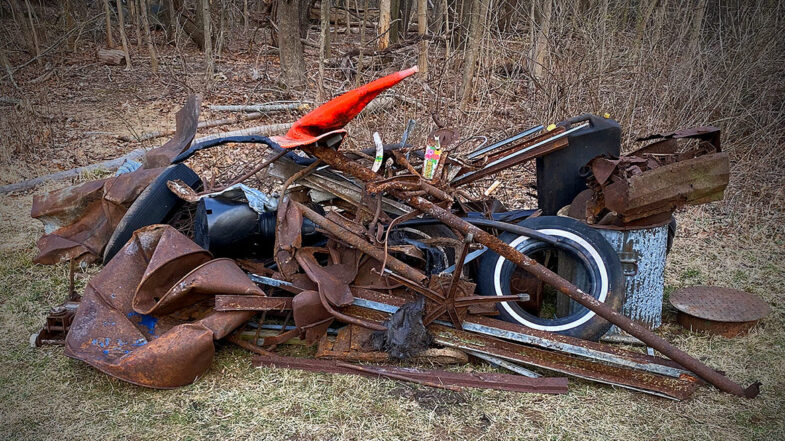
A pile of trash pulled from the local nature preserve. Items include tiles, a traffic cone, pipes, oil drums, trash cans, a manhole cover, plastic pots, fence posts and scrap metal.

Background

When first moving into our house, my wife and I would find little items while digging around our yard. Antique nails from when the house was first built, marbles and toys from the kids who lived here before us, a hinge off of one of the shutters — just little things like that which I started calling “local archeology”. If we found something interesting, I would photograph it and post it on Instagram. Nothing too special and without any real plan. It was just an inside joke between us that I started using as a hash tag.

We’re lucky enough to live across the street from a state nature preserve and as we settled in to our new neighborhood, I began noticing more little things. Most notable was the trash and litter that would build up on the fence line with the preserve. Now, as I would stand around in the yard enjoying a cigar, this really started to bother me. I wanted to enjoy the expanse of forest in front of me without the eyesore of litter ruining the experience. Being of the “see a problem, solve a problem” persuasion, I started wandering across the street and picking up any bottles, cans or plastic bags that I would find along the fence line in front of our house.

Unfortunately, the more I looked beyond the fence deeper into preserve, the more trash I saw. A bit disappointing, but still rather ignorantly undaunted, I started heading into the park with a couple of five gallon buckets to pick up the trash along the roads near the house. The deeper I wandered through the trees through, the bigger the scale and magnitude of the problem became and the true beginning of this project began. What started as just picking up a stray beer can or coffee cup became pulling out large scale commercial and industrial waste from illegal dumping.

The more I looked, the further I explored, the more I found. Each time I returned from a collection hike, I would regale my wife with whatever weird piece of trash I found and if it was interesting, I would snap a photo and post it. The local archeology inside joke moved from our yard to encompass the preserve. As I discovered the serious commercial waste, my wife recommended I start documenting everything — even the mundane. The photo gallery is a summary of many (but not all) of the trash we’ve been pulling out the forest.

The Trash

Starting in March 2023, I started recording how many trash bags I packed full of litter on each hike. Here’s the break down.

MonthTrash Bags
March33
April6
May3
June4
July0
August5
September6
October6
November0
December5
Total68

Each bag has a 33 gallon capacity, so with one gallon weighing 8.33 pounds, it’s a maximum total of 275 pounds per bag for a total of 18,700 pounds or 9.35 tons of trash. In reality, every bag wasn’t always full and there’s no way I (nor the town sanitation staff) could even lift a bag that heavy. Let’s be conservative and say each bag averaged out to around 50 pounds for a total of 1.7 tons. Tons. Nearly, 3,000 pounds of trash collected into bags and removed.

And that’s just trash. We still need to factor in recycling. Every time it’s feasibly possible, I’m also sorting items into our local recycling bin for pickup. In a busy month of hiking, our 35 gallon bin is completely full and 90% of that would be pulled from the preserve. Certain weeks, I’m also including multiple smaller bags full of metal, glass and plastic. While I don’t have any hard data on the exact volume, I’d estimate a full bin about 30 times in 2023 for around 8,700 pounds or 4.35 tons of recycling removed from the park. 4.35 tons of trash that was just rotting in the woods.

Beyond the little stuff you can pick up and put in a bag, there’s also the big stuff. All the larger items that need to be dragged out, picked up by the city or taken to the county dump. Here’s a (partial) list of some of those big ticket items.

  • Gas stove (2)
  • Car frame
  • Car hood
  • Car rear differential
  • Car seat (2)
  • Window frame (2)
  • Cast iron bath tub
  • Cast iron sink
  • Car batteries (7)
  • Lawnmower
  • Exercise bicycle
  • Oil drum (5)
  • Planter
  • Tires (12)
  • Tractor engine
  • Fencing
  • Pipes
  • Cast iron tractor wheels (2)

It’s not until you start to see the totality of the situation that you begin to understand the level of damage. As I said, the numbers aren’t precise, but the pictures speak for themselves and I’m continually astounded (and dismayed) by what I find. I could go on and on about all the little weird things I’ve found.

The Gallery

Despite posting many photos of the smaller interesting finds on Instagram, I realized that many more were filling up my phone and hard drive. Hence the idea for a gallery to really show the effort in full. With only a couple of exceptions from 2022, the photos are all from 2023 and for the most part in chronological order.

The Design

The art direction doesn’t stray far from the general template I’ve been using recently for other single page projects. A header linking a back to the blog post, the main body of content and a footer with links off to other projects. From there, it’s a matter of styling and customization to fit the project theme.

The general inspiration comes from some of the archeology publications and sites. Sadly, they weren’t very inspiring as they’re designs were often outdated. About the most I could take from their pages was the serif headline, sans serif body copy pairing which, of course, isn’t very unique.

The color palette is Flexoki which is my new favorite as it speaks to my experience in print graphic design. The muted colors are warm and balanced. Admittedly, the design doesn’t take advantage of the full palette only using a few of the colors. It does use both light and dark themes depending on your settings. I’m fairly sure I’ll use the palette in future projects to really explore the full color set to see how they work across different design themes.

The fonts are Playfair Display for the headline (served locally) and Gibson for the body (served via Adobe). I really do love a heavyweight serif face and Playfair really looks great to convey a level of academic prestige (even if it’s a false notion). Gibson is used more sparingly as the gallery doesn’t really have much text. Again, the heavyweight version of the face are just fantastic and I really like how it looks for the subheads.

The Code

Like with the design, the basic template is the same as other recent projects using a CSS grid for the responsive layout. The only difference this time was to experiment with some column/row spans to mimic a masonry effect and showcase larger versions of some of the more interesting finds. It’s not a true masonry grid, but at certain viewport sizes, all the items nest and align nicely. At other sizes, gaps do appear, but that’s expected. There are Javascript libraries to achieve that true masonry effect, but here, where all the photos are the same aspect ratio, the JS overhead and complexity didn’t seem worth it.

Each photo has the opacity dimmed a little which normalizes on hover. This lets the photos blend a bit more with the color palette. On mouseover, they transition to appearing brighter and more rich which gives them impact. The photos can also be clicked on to open larger in a modal window. I’m using the a11y dialog script for the modal behavior. I experimented with adding a keyboard activated previous/next behavior to the modal, but kept getting the array numbering messed up in my Javascript, so I left it out. An update for another day or another project.

The Impact

It’s a fair question to ask: Is this work having a positive or negative impact on the preserve? I’d argue that it’s having a positive impact. I work from the motto of yes, there may be some short term disruption, but it results in long term benefits. Similar to the idea of “leave no trace,” I work to repair any soil disturbance and contrary to the “archeology” title, there is no digging of any kind. Likewise, I rotate the areas I work in over days and weeks to allow the wildlife to reclaim the space. I’m also time limiting my work, so that I’m not in the area for more than an hour or two at most.

There is, of course, also an impact on me. I love walking in the woods and coming upon a new debris field or trash pile can turn my emotions upside down. Sometimes it makes me angry and frustrated. Other times, just sad and disappointed. Sometimes, its just too much and I can’t handle tackling an area as it just feels overwhelming. I’m starting to realize I need to work on a better balance to approach the work only when I’m in the right state of mind. On the positive side, there’s is a sense of pride when I’m able to remove a giant piece of junk from the preserve. I’m also stubborn, so I keep going back for more. It’s almost like to trying to finish a video game quest as it taps into your competitive nature. Maybe one day, I’ll come back from a walk with an empty bucket.

The Future

One of things I’ve come to notice is that the forest wants to get rid of the trash. It wants to be healed. Bottles and cans seem to be pushed up from the soil. Storms, rain, snow and animals uncover items bringing them to the surface. I can pick an area clean only to come back a month later to find more. I have to remind myself all the time that I’m not going to find it all today.

Will I continue? Yeah, most likely. There are three areas of commercial dumping (one in a federally protected wetlands) that I haven’t tackled yet. I know those areas will weigh on my mind if I don’t try to clean them up. I’m not going to stop walking in the woods and the benefits of doing that (exercise, fresh air, quiet) make the potential emotional turmoil worth it. I do get to see amazing things on almost every walk and I’m now starting to learn (and report) more on the ecology for my wife and her non-profit.

Finally, a thank you and shout out to the local sanitation department who has unwittingly been helping with this effort. I can only imagine what they’re thinking when the roll up to our house and see what I’ve put out for collection. Same goes for the county hazardous materials recovery facility. They’re always friendly, helpful and accommodating when I bring in a truck load of crazy stuff.

Please don’t litter.

View the photo gallery